
|
The
basics of Ayurveda
The
following are some of the principle theories and practices of Ayurveda.
Ayurveda
is divided into eight parts. Hence it is also known as Ashtanga
ayurveda.
These are as follows: Kaya, Bal, Graha, Urdhwa, Shalya, Dhanstra, Jara,
Vrishan.
1. Kaya: The part of ayurveda which mainly related with diseases related
with body, related with digestion.
2.Bala: It is related with the paediatric age group. It is the treatment
for the proper growth and diseases of children.
3.Graha: It deals with stars and planets and other mental disorders.
4.Urdhwa: The diseases of upper part of the body above the neck. This part
is also known as Shalakyatantra. In this part, disorders of ear, nose,
throat, eyes, and oral cavity are considered.
5.Shalya: This is surgical branch of Ayurveda which is well developed by
Sushrut.
6.Dhanstra: It is related to the tooth where animal bites, poisoning and
its treatment is considered.
7.Jara: It is the branch related to geriatrics. It deals with treatment to
avoid old age.
8.Vrushya: It is the branch related with healthy sex life and treatment
related to complaints about intercourse etc.
Prakruti: At the time of conception, the particular dosha
dominating is the prakruti of that individual.According to individuals
prakruti, he or she is prone to some types of disease. To cure those
disorders, some hints related to day to day life "dincharya" and
seasonal behavior "Rutucharya"are given.
Panch Mahabhoot Siddhanta: The whole body is considered to be made
up of five basic elements such as Prithvi, Aap, Tepa, Vayu and Aakash
.When there is disturbance in dosha-dhatu-mala, the individual suffers
from disease. Hence they should be treated accordingly.
The treatment part includes Shodhan and Shaman. In Shodhan, the doshas are
expelled out of the body with the help of medicines and in Shaman , doshas
are suppressed in the body. Shodhan includes five ways of cleansing named
as Pancha karma. It includes;
Vaman: emesis,
Virechan: purgation,
Nasya: medicine administered by nostrils.
Raktamokshan: letting out blood,
Basti: medicated material administered through anus.
Prakruti - The Unique Genetic Code of an Individual
Everyone knows that there are no two fingerprints alike. No two voice
modulations and no two genetic codes are exactly alike. What makes anyone
think we all have the same liver, lungs, kidneys, or anything else the
same as the next person. Therefore to propose that we all eat the same
foods, take the same drugs when we are ill, or perform the same exercise
is more than ludicrous. It is unscientific! Ayurveda uses a system of
historical analysis and physical examination done almost entirely by
observation (with the exception of pulse reading), to ascertain one's
original nature and current imbalances.
A diet and health plan are given to the individual according to the needs
to correct the imbalance. The basis for all other concepts in Ayurveda is
Sankhya (the analytical study of the elements that comprise the universe).
Although the modern physicist would delineate well over one hundred
elements, Sankhya states there are twenty-four, of which five are the
foundation of the gross world: Earth, Water, Fire, Air and Ether.
These five elements, when joined in different combinations, make up the
three "doshas" or "biological modes" which are the
"Prakruti" or nature of an individual and the nature of all
things.
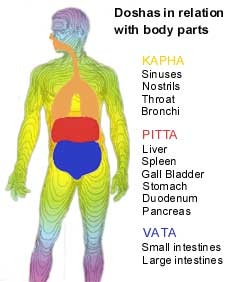
The combination of air and ether gives us Vata or the Kinetic
Biological Mode. Vata is that which is electric in the body and causes all
movement in and out of the system (breathing, urination, defecation,
menstruation, etc.)
The combination of fire and water gives us Pitta or the
Transformative Biological Mode. Pitta is that which mutates or transforms
the outside elements of the macrocosm into the inside elements of the body
(the microcosm). Pitta governs the digestion of physical, mental, and
emotional elements.
Finally, the combination of earth and water gives us Kapha or the
Structive Biological mode. Kapha is that which makes for both lubrication
(mucus, synovial fluid) and structure (bones, muscles, fat, joints, etc).
Generally speaking most people are a combination of two modes. One is the
primary and the other is the secondary. But there are those who are purely
dominated by one mode, and in rare cases, those who are a mixture of all
three. This elemental theory broken down into divisions of modes identifies
not only body types for humans, but also for animals, vegetables, plants,
herbs, geographical locations, times of day, seasons of the years, and
activities performed.
Everything in the universe is categorized by this system. Ascertaining one's
Prakruti (nature of constitution) and imbalances is the service rendered by
the Ayurvedic analysis using the processes stated earlier. Then the Ayurvedic
practitioner constructs a diet and recommends herbs which would be helpful to
regain balance with one's original nature.
In Ayurveda different people with the same disease sometimes receive different
diet and herb plans. The constitution, the imbalance, and the various nuances
of the development of the disease in each individual must be studied to
determine the nature of the imbalance whether Vata, Pitta, or Kapha for that
disease.
For example: Two people have a history of weak lungs and chronic coughing. One
is dominated by a Vata constitution with a Vata imbalance. The other is
dominated by a Kapha constitution with a Kapha imbalance. The Vata has a
tendency towards a dry hacking cough in which no mucus or phlegm is present or
being expelled. The Kapha has a less frequent, but heavy wet cough which
expels large quantities of mucus and phlegm.
For the Kapha dry, hot, spicy herbs and foods are what is necessary for
burning up and drying up the excess mucus. Dry ginger, and long pepper are
useful while all dairy, fruit juices, and cold food in general are to be
avoided. But for the dry Vata cough, hot milk with turmeric is a great healer
to soothe and calm the cough, while disinfecting and moistening the dry, hot
lungs. Fresh curd with unleavened whole wheat bread (chapatis) and cooling
fruit juices are also useful. So a cough is not just a cough according to
ayurveda. But according to the constitution and imbalance, "One man's
food is another man's poison".
Unfortunately people will give up trying holistic health practices because
good food was given to the wrong person. The secret of understanding the
dynamics of food and which food is for whom is in the taste, therefore, the
appropriate tastes with their elements will correct the imbalance of elements
in one's constitution if taken correctly.
The proof is in the tasting.
There are six tastes according to Ayurveda: Sweet, Sour, Salty, Pungent,
Bitter, and Astringent. Each is comprised of two elements:
Sweet (earth and water) examples: wheat, sugar, milk, rice, dates;
Sour (earth and fire) examples: yogurt, lemon, tamarind;
Salty (water and fire) examples: sea salt, rock salt, kelp;
Pungent (fire and air) examples: onion, radish, ginger, chilly;
Bitter (air and ether) examples: dandelion root, rhubarb root, bitter melon;
Astringent (air and earth) examples: plantain, pomegranate, apples;
There are two other considerations in Ayurveda. First, whether a foods action
is heating or cooling. The taste sweet, bitter, and astringent are cooling.
Sour, salty, and pungent are all heating. The second is the post-digestive
effect or how the foods "taste" to the tissues during and after
assimilation. Sweet and salty are sweet in post-digestive effect. Sour is
sour, and pungent, bitter, and astringent are pungent.
Taste, action, and post-digestive effect are known is Sanskrit as rasa, virya,
and vipack respectively in Ayurveda. They are the keys to understanding food
and herbs. With this knowledge, one can unlock the mysteries of the energetic
dynamics of food and be able to make the right choices for oneself.
Raw Foods According To Ayurveda
Raw foods and juices are magnificent in that they are cleansing and
energizing. Sprouts are especially wonderful because they contain large
amounts of enzymes and nourishment which help with digestion and assimilation
of nutrients. Some of the spicier sprouts help to destroy and eliminate toxins
in the system known as ama in Ayurveda.
Fenugreek sprouts can even help in cases of seminal debility. But in general,
raw food is very cold and hard to digest in the Vedic sense as it releases its
Prana or nourishing life giving energy in the upper portion of the body
between the mouth and the stomach. This gives quick, short-term energy, but
not long-term tissue building nourishment. This is good for pittas, and some
raw foods are good for kaphas, but this is not very good for vatas.
Cooking Foods According to Ayurveda
Well cooked grains, beans, and vegetables release their Prana in the colon.
This provides long-term tissue building energy. However, these energies cannot
be released from complex carbohydrates without the assistance of enzymes. A
Clean intestinal tract is also essential for proper absorption.This coincides
with two of the modern holistic health theories of colon cleansing and enzyme
consumption. But the Ayurvedic approach again is practical and individualized.
Which herbs for which constitution will produce the best colon cleansing
varies. Therefore, some people find some of the standard colon cleansing
products ineffectual or difficult for their bodies to tolerate.
Triphala ("the three fruits"), used in Ayurveda, is one of the best
colon cleansers because it strengthens and tones the muscle action of the
colon. It does not cause laxative dependency by doing the work for the colon.
Similarly, the consumption of enzyme tablets will cause the digestive organs
natural ability to produce enzymes for digestion to become suppressed and lazy
and possibly lose their ability to function all together. Ayurvedic cooking
uses certain herbs and spices to help stimulate the body to produce its own
digestive enzymes.
The Secret of spices in Ayurvedic Cooking
Spices used in small to moderate proportions according to the food being
prepared and the person's constitution will stimulate all the digestive organs
to produce the enzymes required for total absorption and assimilation. This
lets your organs do their work through nourishment without "putting them
in a wheelchair" while the chemicals do it. Thus cooked food and spices
are better for the poor digestion of kaphas and vatas. Pittas should use only
mild spicing, as their "fire of digestion" is generally strong.
Consciousness and Food
This is probably the most important aspect of Ayurveda: Your state of
consciousness when you eat and when you cook. One of the great sages of India,
Rupa Goswami wrote: "If you eat food prepared by the wicked, you will
become wicked". If the person who is cooking has fears, insecurities,
anger, jealousy, greed or any of many emotions we experience everyday, the
chef will infuse that preparation with that emotion.
This is important to remember in eating - at home or away - that the
consciousness of the cook is in the food. And the consciousness of the animal
or vegetable one is eating is in there as well. So in Ayurveda, food
preparation is considered a sacred act. Animal food is generally not
recommended because of the extreme pain, agony, suffering, fear, anger and
terror the animal experiences has gone into the food. Add the highly toxic
chemical contamination of modern factory farming like hormones, steroids,
antibiotics, pesticides, etc., and you have a prescription for death not life.
Vegetables have life also and they also feel pain and discomfort at being
eaten. The Vedas teach that each living being, from the king to the bacteria,
has a soul and is therefore sacred. The kitchen is considered the extension of
the altar in Vedic culture. In early Christianity, the people would bring
their crops and lay them at the altar for sacrifice and blessing.
This was done much earlier in Ancient India, only there everything was
prepared in the kitchen according to the principles of taste and elemental
energetics and then offered with great devotion to the deities.
You can do this at home by preparing your food with love according to
Ayurvedic energetic principles and offering prayers and meditations of thanks
and love to God. You will transform food into prasad or God's mercy. Thus you
will raise your physical, mental, emotional, and spiritual health to the
highest possible levels. There is no greater nourishment than this in all the
world.
Email
this page to a friend
|